No clock in the world is more instantly recognised than the cuckoo clock — the carved wooden house, the swinging pendulum, the little bird that bursts out to call the hour. Yet almost everyone gets one basic fact wrong about where it comes from.
◆ First, the myth: it is not Swiss
Many people believe the cuckoo clock is Swiss. It is not. The mix-up is so common that a famous 1949 film, The Third Man, even repeated it on screen — and the line stuck in the public mind for generations. The truth is that the cuckoo clock is unmistakably German, born in the Black Forest (Schwarzwald) of south-western Germany. Switzerland gave the world the fine wristwatch; the Black Forest gave it the cuckoo clock. They are two different traditions, two different countries.
◆ Born from poor farmers’ long winters
In the early 1700s, farming families in the central Black Forest faced long, snow-bound winters with little to do and little income. Surrounded by cheap, plentiful wood, they began carving clocks by hand to sell. Out of this winter craft, around the villages of Schönwald, Schonach and Triberg, the cuckoo clock was born. Tradition credits a Schönwald clockmaker, Franz Anton Ketterer, with adding the calling bird in the 1730s, though the exact origin is still debated by historians. What began as survival slowly became an art.
“What started as the winter work of poor farmers became, in time, a craft the whole world wanted on its wall.”
◆ The “railway house” that conquered the world
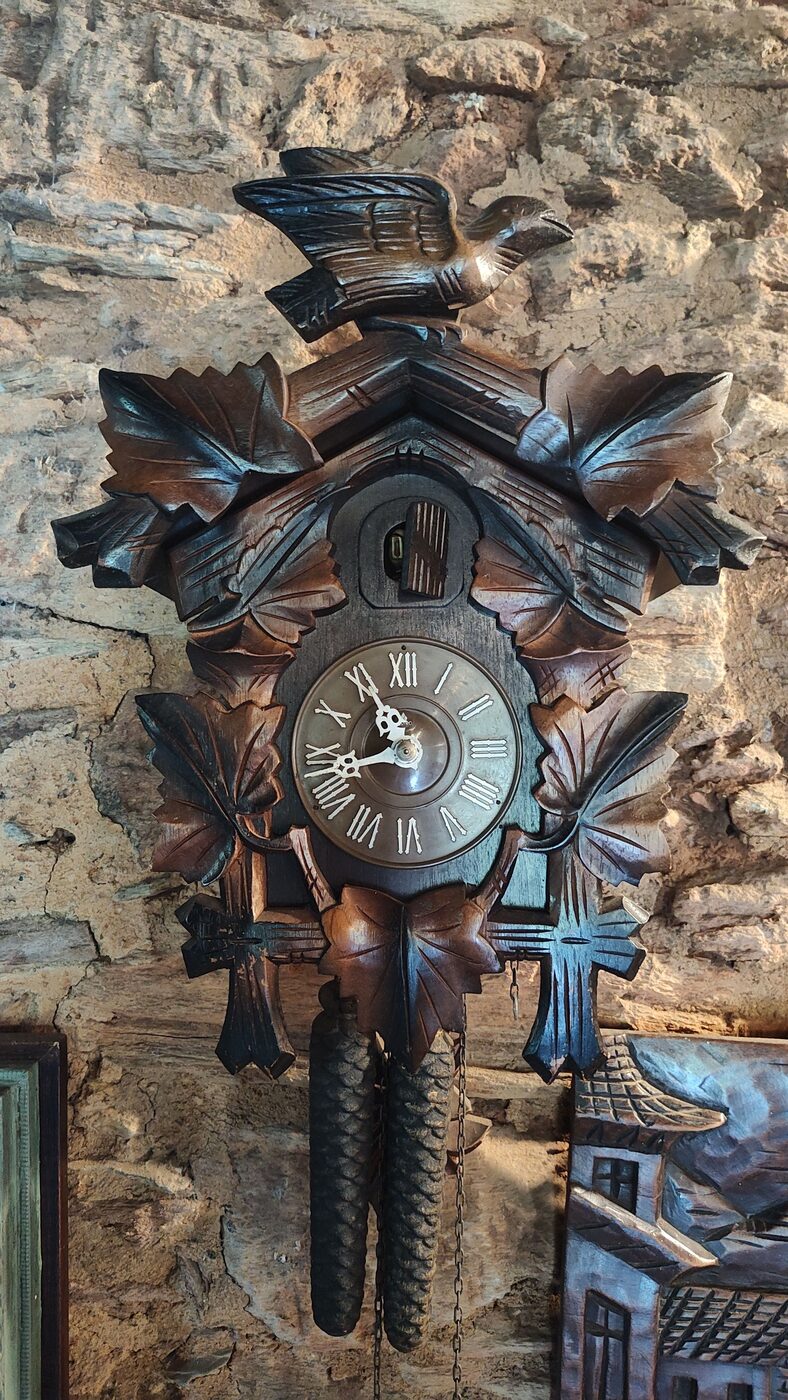
The shape we all picture today — the little carved house with a peaked roof — came in 1850. The Grand Duchy of Baden ran a competition to modernise the clock, and an architect named Friedrich Eisenlohr, who was then building stations along the new Black Forest railway, submitted a design based on a railway guard’s house draped in vines. It was called the Bahnhäusle (“little railway house”), and it became the first cuckoo-clock design to be mass-produced. From that moment the Black Forest cuckoo clock spread across the world. The pine-cone shaped weights you still see today are a small echo of that era.
◆ How a cuckoo clock actually works
A traditional cuckoo clock has no battery. It is driven by a weight on a chain — gravity slowly pulls it down, and that falling energy turns the gears that move the hands. A pendulum swings beneath, keeping the beat steady. The famous call is pure mechanics: as the hour strikes, the clock works two small bellows, each pushing air through a little wooden whistle pipe tuned to a different note — together they sound the falling “cu-ckoo” — while a lever pops the bird out through its door. Clocks come as 1-day (wound daily) or 8-day (wound weekly) movements; you simply draw the weights back up by hand.
◆ How to spot a real one
Because the cuckoo clock is so loved, the market is full of cheap look-alikes. A genuine Black Forest clock carries a certificate of authenticity from the VdS (Verein die Schwarzwalduhr — the Black Forest Clock Association), founded in 1987 to protect the craft. To earn the VdS seal, a clock must have a mechanical movement and be made entirely in the Black Forest, of wood throughout except the brass movement. “Black Forest Cuckoo Clock” is itself a protected name, and the seal has carried a registered trademark since 2006. If you ever buy one, look for that certificate — it is the difference between a souvenir and an heirloom.
◆ Where to see them — and the makers
The village of Schonach is still considered the heart of the cuckoo-clock world, and the German Clock Museum in Furtwangen holds some of the oldest examples. The makers themselves — long-running family workshops such as Anton Schneider, Rombach & Haas, Hubert Herr and others — still hand-carve clocks there today. You can explore Germany’s watch and clock makers on our Germany page, and learn about the craft’s guardians at the Black Forest Clock Association (VdS).
The cuckoo clock is a perfect little story of what this site is about: a real object, made by real people, in a real place — carried from a snowed-in Black Forest village to living rooms all over the world.